The Readability Target Plan
Take a piece of writing to a Reading Ease or grade-level target with the fewest edits: both scales named, a clean count, the syllable ceiling, the price of every edit, and when to stop
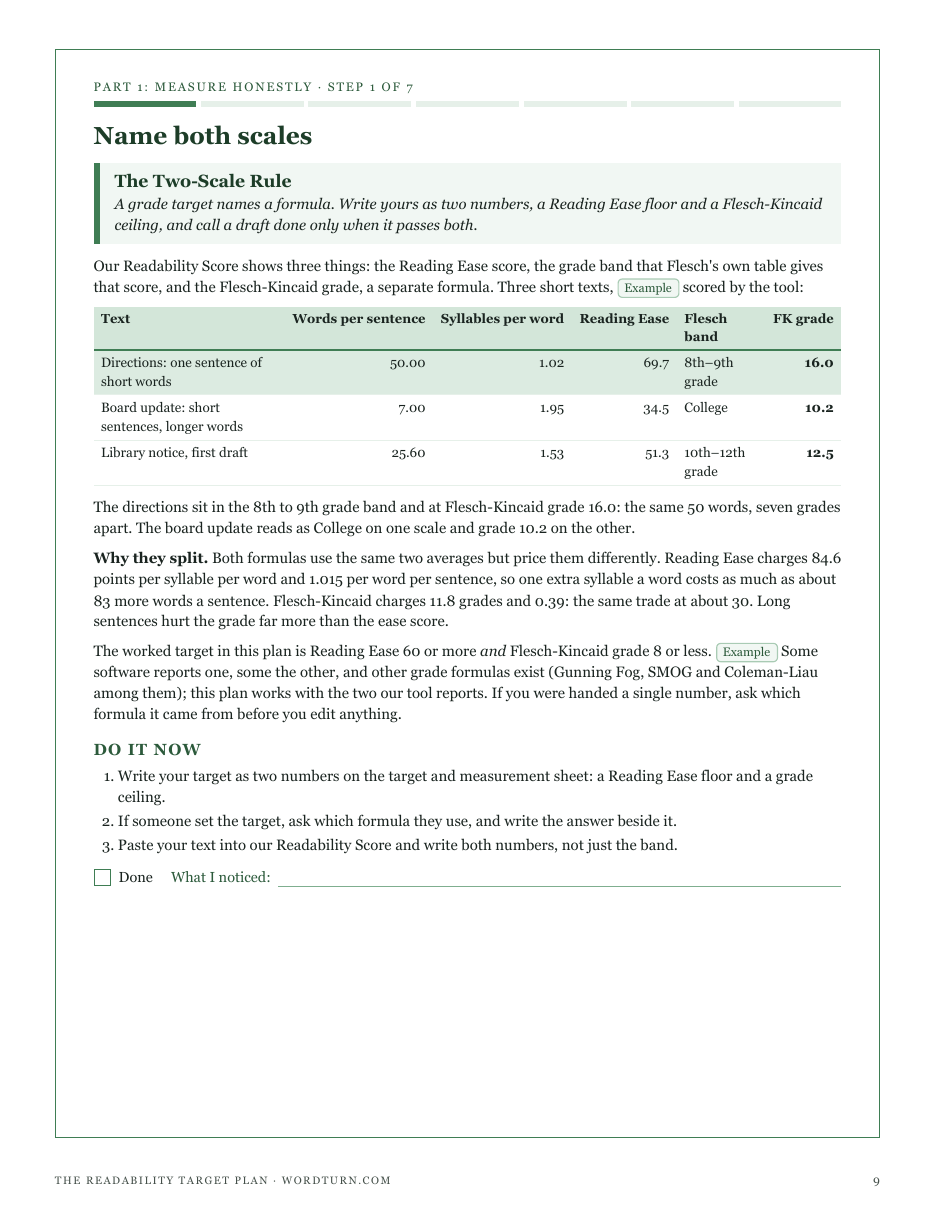
WordTurn's Readability Score tells you what a text scores. People who use it usually have a target to hit, and that is harder than it looks: the tool reports two formulas that disagree (one 50-word sentence of short words sits in the 8th to 9th grade band and at Flesch-Kincaid grade 16), the syllable count behind both is an estimate, and pasted text fools the sentence count. An unpunctuated list cost a sample notice 5.8 points; one "e.g." flattered it by 5.7. The Readability Target Plan turns the score into a plan. It writes your target on both scales, cleans the text before it counts, checks the syllables by hand, finds the most syllables per word a target allows at your sentence length, and prices every split and every shorter word before you make it. In the worked example a 128-word library notice scores Reading Ease 51.3 and grade 12.5; word swaps alone would need 49 syllables gone, while four splits and a one-syllable cut clear Reading Ease 60 and grade 8. The split draft passed Reading Ease and missed the grade by a tenth; five plain swaps finished it at 71.7 and grade 7.0, and the plan says stop there. Every score and budget in it is computed by the same code as WordTurn's tools, and every passage and target is an example. A readability score measures length, not quality, and the plan says so. Included: a 23-page printable PDF with seven steps, a target and measurement sheet, an edit budget worksheet, a sentence map, both scales side by side and a quickstart, plus a personalised sheet worked from the counts in the tool you came from.
Look inside
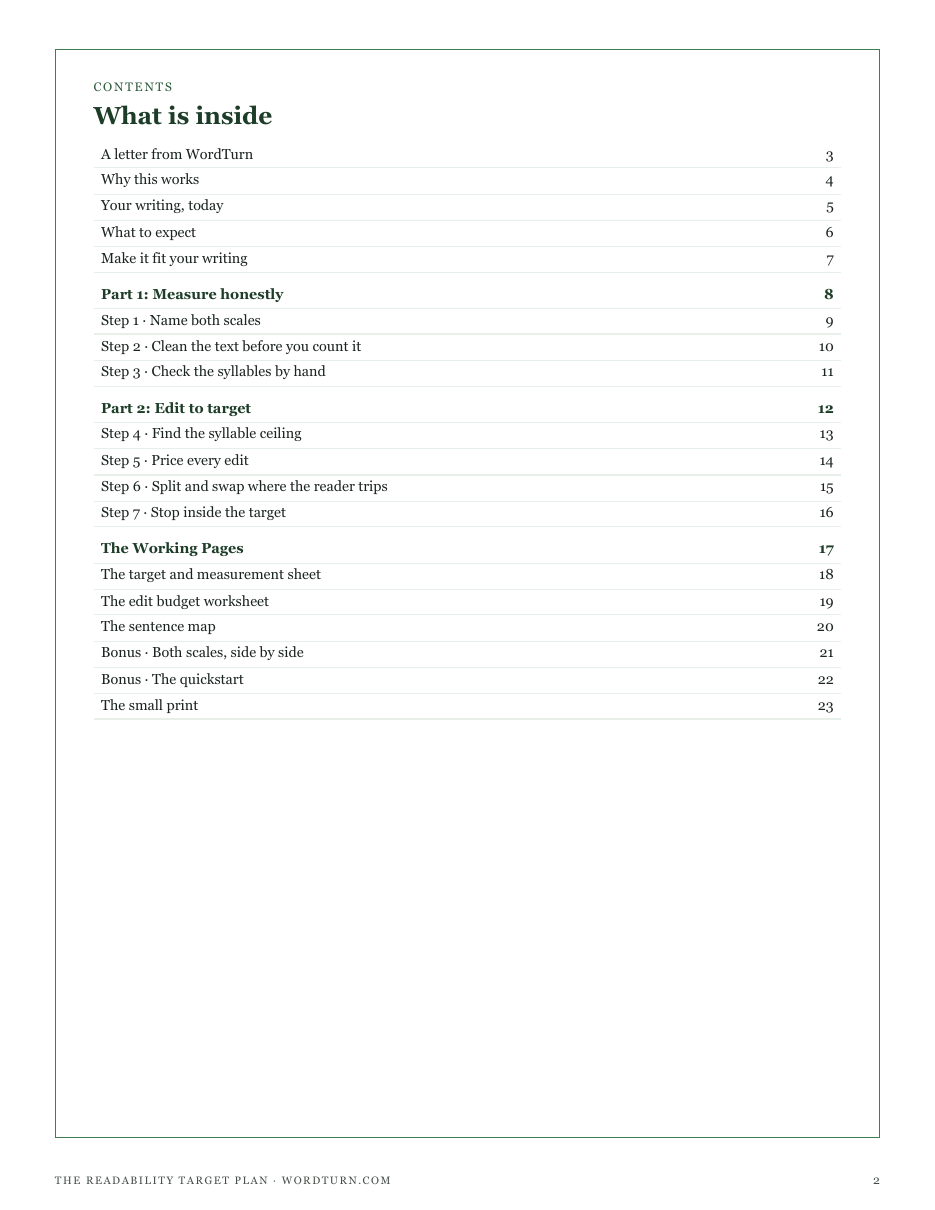
Two full pages from the pack, exactly as printed. Click either to read it at full size before you decide.
What is in it
- The Two-Scale Rule: write a target as a Reading Ease floor and a Flesch-Kincaid ceiling, and pass both
- Clean Before You Count: the heading, list and abbreviation traps that move a score by about 6 points
- Count Twenty by Hand: where the syllable estimate goes wrong and what each syllable is worth
- The Syllable Ceiling: the most syllables per word a target allows at each sentence length
- Price Every Edit: what one split and one syllable buy, and an edit budget from 0 to 6 added sentences
- The Score Cannot See Which Sentence: split where the reader trips, then swap the words they would not say
- Stop Inside the Target: the worked notice draft by draft, and what the score cannot check
- Working pages: target and measurement sheet, edit budget worksheet, sentence map
- Both scales side by side: Reading Ease and grade grids, Flesch's bands, ceilings for six targets
- A quickstart, and a personalised sheet worked from your own text's counts
- ✓ 23 printable pages
- ✓ 10 sections, worksheets and templates
- ✓ A second PDF worked out from the numbers you enter
- ✓ No account needed, just an email address
- ✓ Instant download; link valid 7 days
Price includes any taxes. Sold by GrabURL, who handle checkout and support. The charge appears on your statement as GrabURL.
The plan picks up where the free Readability Score, Syllable Counter and Word Counter leave off. They tell you what a text scores; the plan tells you which scale your target is on, how far off you are on each, and which splits and word swaps close the gap with the fewest edits. Both formulas only count lengths, the syllable count is an estimate, and every passage and target in the plan is an example: a readability score measures length, not quality, so the plan also tells you when to stop.